Category: Blogs

  • A look at Badminton’s history, Indian Stars, Rules and World Championships

    A look at Badminton’s history, Indian Stars, Rules and World Championships

    A look at Badminton’s history, Indian Stars, Rules and World Championships

    A look at Badminton's history, Indian Stars, Rules and World Championships

    One of the world’s favorite sports, badminton is full of wonderful memories and adventures. Its roots can be traced back to ancient civilizations in Greece, China, and India that popularized sports similar to modern badminton using racket and shuttlecock. 

    • By the eighteenth century it had become immensely popular among reputable English people. Badminton House became known as an arena for tournaments involving this sport.
    • In 1873, the Duke of Beaufort hosted an event where the game was formalized and named in honor of the estate. Badminton soon became a popular sport throughout England as well as in other countries, before it became an official sport in the 1930s. 
    • A global federation was created and was named Badminton World Federation. Badminton World Federation (BWF) which is responsible for overseeing international competitions and increasing awareness of the sport across the globe.

    Badminton is famous for its frantic rallies that require agility, precision and a well-planned strategy. Since 1992, it has been an Olympic sport which continues to gain international recognition as athletes from all across the globe compete in events such as those of the All England Championships and BWF World Championships.

    Today, badminton is widely celebrated due to its competitive and inclusive nature; drawing participants of all ages and abilities. The sport’s remarkable history of Badminton shows its development from an obscure pastime into one enjoyed by millions worldwide.

    Indian Badminton Participants: Rising into New Heights and Medals

    Indian badminton players have seen incredible global success over recent years, leading to a dramatic transformation in badminton as a sport. 

    • Prakash Padukone and Pullela Gopichand set the stage for the next generation of stars. Their successes and accomplishments fueled a whole young generation who aimed to compete at the highest level in badminton.
    • Saina Nehwal, PV Sindhu, and Kidambi Srikanth are famous players of Badminton in the 21st century. They were the first to excel at international competitions such as the Olympics, Commonwealth Games, World Championships with dedication, and a good connection with top coaches like Pullela Gopichand.
    • PV Sindhu forged a record at the Rio Olympics in 2016 when she became the first Indian woman to win the Olympic Gold medal in badminton during that event. This accomplishment was the catalyst that brought Indian badminton onto a global scene. 
    • Saina Nehwal‘s bronze medal from the 2012 London Olympics also confirmed India’s position in the sport.

    The support of the government, improved infrastructure, and increasing corporate sponsorship also play important roles in fostering talent, and offering opportunities for exposure and training. 

    In the end, Indian badminton has continued to flourish with players consistently ranked among the top players in the world and winning medals from world-class tournaments.

    The Game of Mastery: Badminton Rules and Regulations

    Badminton is a frantic and thrilling sport which is played over a square court that has a net in the middle. The aim is to strike a shuttlecock through the net with a paddle, with the aim of landing on the court of your opponent. These are the most important rules to know:

    • Scoring: Games are usually played in the best-of-three-games. Every game is played with 21 points. Players earn points every time the shuttlecock is placed in the court of their opponent or when the opponent makes a mistake.
    • Serve: A serve has to be thrown at the waist, as well as diagonally over the net. The receiver and server must remain within their respective courts of service for the duration of the serve.
    • Rally: Participants hit the shuttlecock in a back and forth motion trying at keeping it within the play. The shuttlecock may only be hit one time per side, and then it can cross the net.
    • Faults: A mistake can occur when a shuttlecock falls beyond the boundary and does not clear the net, is hit two times, or if players touch the net by putting their body on it or using a racket during the game.
    • Winner: The first player or couple who wins two games takes the game. When the score is 20-20, the game will continue until one of the players or pairs has a lead of two points.

    Knowing these rules will allow players to take advantage of the agility and strategy required in badminton. It’s a sport of accuracy and skill and mastering the fundamentals can lead to exciting games and rallies.

    Uncovering the Excited: Badminton World Championship

    The Badminton World Championship stands as the highest level of the sport. It is where the top players in the world meet to show off their talents and fight for glory. The annual competition attracts athletes from around the globe, all seeking to be etched in the history of badminton.

    • It is organized by the Badminton World Federation (BWF) The championship consists of singles, doubles, as well as mixed doubles competitions. 
    • Participants are selected based on their rankings in the world and on how they perform at international tournaments all through the calendar.
    • The tournament is played over several days, with games held in knockout style leading into the championship. 

    Legends like Lin Dan, Carolina Marin, and Viktor Axelsen are past champions whose remarkable performances have left a lasting impression. Along with honoring each player’s unique skill, the competition promotes international cooperation and good sportsmanship.

    Being a winner at the Badminton World Championship is a desire for all players, representing years of hard work, intense training, and a strategic game. It’s a guiding light for athletes who are aspiring around the world and inspires players to aim for excellence in the exciting and thrilling game of badminton.


  • What Are the Challenges of Playing Sports in Cold Weather?

    What Are the Challenges of Playing Sports in Cold Weather?

    What Are the Challenges of Playing Sports in Cold Weather?

    Playing sports in cold weather can be a lot of fun, but it also comes with its own set of challenges. Whether you’re playing regular sports in winter or enjoying winter sports in India like skiing or ice skating, the cold can make things tricky. While winter sports in India are becoming more popular in places like Gulmarg and Manali, it’s important to understand the challenges that come with playing in colder temperatures.

    1. Risk of Injury

    One of the main challenges of playing sports in winter is an increased risk of injury. Muscles and joints become stiffer when exposed to cold conditions, making them more likely to strain and sprains. Cold temperatures make it harder for your body to warm up properly when participating in any physical activity. So, stretching and warming up before playing any sport, especially winter sports in India like skiing and snowboarding can be particularly risky without proper preparation for their cold conditions.

    1. Breathing Difficulties

    Cold air can make breathing harder when engaging in physical activities. Cold air may irritate your airways and result in shortness of breath – making playing sports in cold weather even harder for some individuals with asthma or other breathing conditions. Wearing a scarf or mask over your mouth to warm the air before breathing in can make playing sports more manageable during harsher conditions.

    1. Reduced Performance

    Playing sports in winter conditions can negatively impact your body. Your muscles must work harder just to stay warm, leading to fatigue more rapidly than playing in warmer conditions. Your performance might suffer and fatigue could set in faster than usual – for instance playing football or cricket could feel exhausting since extra energy must be put in to stay warm. Keeping this in mind should you play sports in winter is essential!

    1. Cold-Related Illnesses 

    If you play sports outside in the cold for too long, you could have the risk of cold-related illnesses such as cough and fever. Frostbite occurs when too much cold penetrates skin layers that freeze over, usually fingers, toes, nose or ears. Hypothermia occurs when body temperatures drop too far below what’s safe – both can be potentially dangerous conditions. To stay safe it’s essential to dress warmly by layering warm layers while covering exposed skin while staying out for as little time as possible as well.

    1. Slippery Surfaces

    In cold weather, dew drops can make surfaces slippery. This is a big challenge for outdoor sports like football or cricket in winter, especially if you’re playing on grass or turf that has frozen. The risk of slipping and falling is higher, which can lead to injury. Winter sports in India, like skiing or snowboarding, can also be dangerous if you’re not careful about icy patches on slopes. Wearing the right shoes or equipment and being mindful of the surfaces you’re playing on is key to preventing accidents.

    1. Limited Access to Outdoor Facilities

    Another challenge related to playing sports in cold weather is limited access to outdoor sports facilities during winter months. Cricket fields might be covered in dew drops, while football grounds might be too slippery to play on. Winter sports enthusiasts typically travel specifically to Gulmarg or Auli for skiing and snowboarding activities; this may limit opportunities for people elsewhere in India who would like to experience winter sports activities.

    1. Dressing Appropriately

    One of the biggest challenges associated with playing sports in cold weather is knowing what to wear. Too many layers could leave you overheated and sweating, leaving you uncomfortable. Make sure to wear moisture-wicking clothes underneath to keep sweat away from your skin, and a warm jacket or fleece on top to keep you insulated.

    1. Shorter Days

    Winter’s shorter days bring with them less daylight for outdoor sports activities, limiting how long we have available to us to play or practice outdoor sports such as cricket or football – meaning less opportunity to practice or compete during daylight hours. In India, skiing requires good visibility so this reduction could greatly limit how long one spends on the slopes.

    Conclusion 

    Enjoying winter sports can be an exhilarating experience, yet it comes with several unique challenges. Being aware of potential injuries or cold-related illnesses that could occur is vital, and taking steps such as dressing appropriately and warming up properly are necessary steps in staying safe while still enjoying playing your chosen sports in India this winter season.

  • What Are the Key Benefits of Gymnastics for Kids?

    What Are the Key Benefits of Gymnastics for Kids?

    What Are the Key Benefits of Gymnastics for Kids?

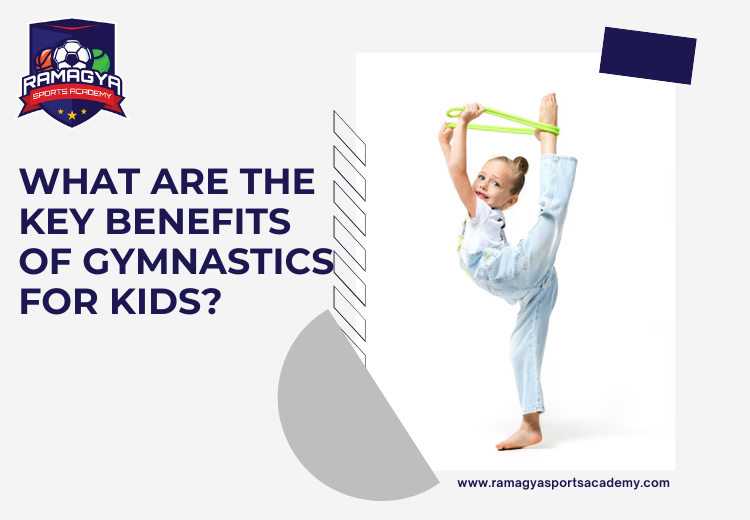
    Gymnastics is an exciting and energetic sport that many kids enjoy. It involves physical exercises that help build strength, flexibility, and coordination. For beginners, gymnastics might seem challenging at first, but with time and practice, it becomes an amazing way to stay active and learn new skills. 
    In this blog, we’ll explore the benefits of gymnastics for kids and why it’s an excellent choice for beginners.

    What is Gymnastics? An Introduction to the Sport

    Before looking at the benefits, it’s important to know what is gymnastics. Gymnastics is a form of exercise which involves various activities on equipment like mats, bars, and beams that teach kids flips or jumps as well as balance exercises. Gymnastics for beginners generally concentrates on the fundamental techniques and movements. It helps kids build confidence and develop a strong foundation.

    • Develops Physical Fitness: Gymnastics workouts strengthen muscles, increase flexibility and increase overall fitness levels. This is particularly beneficial for children who are growing.
    • Encourages Active Lifestyle: Understanding what it is and participating in it helps kids remain active, while establishing healthy habits that they can carry to adulthood.

    Physical Benefits of Gymnastics for Kids

    Gymnastics is an excellent option for kids to enhance their physical fitness. The benefits of gym go beyond the sport as it impacts the overall fitness level of children and their ability.

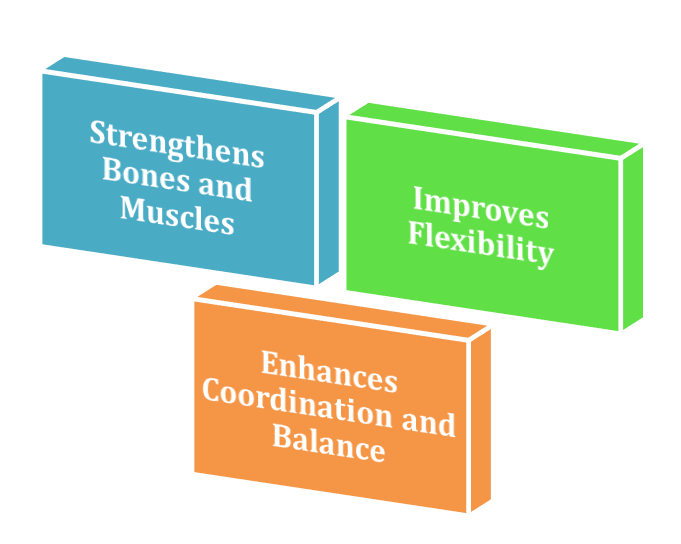
    • Strengthens Bones and Muscles: Gymnastics uses the body’s weight to build muscles and build bones. This makes kids stronger and increases densities of bone, which helps them throughout their development.Physical Benefits of Gymnastics for Kids
    • Improves Flexibility: Flexibility is a must for all sports and physical exercises. Gymnastics for beginners typically involves stretching and fundamental moves that improve flexibility, which reduces the chance of injury.
    • Enhances Coordination and Balance: Gymnastics demands a lot of coordination and balance because children develop the ability to use their body in different ways. This can be transferred to everyday activities as well as other sports.

    Gymnastics Boosts Mental Health and Confidence

    In addition to physical benefits, gymnastics classes are an excellent way to develop your mind. Kids are taught to face difficulties and develop confidence in themselves as they develop new abilities. The benefits of gymnastics extend beyond physical strength and help youngsters develop mental resilience.

    • Improves Self-Confidence: Gymnastics for beginners helps youngsters to set achievable goals and to celebrate every achievement. This helps them build confidence as they discover their abilities and can see the progress they have made.
    • Encourages Discipline and Focus: Gymnastics demands concentration, practice and perseverance, which helps kids to develop discipline. The process of learning gymnastics and learning new techniques will teach kids to be committed and persevering.
    • Lowers stress: A physical exercise such as gymnastics can help to release energy and ease stress. It offers kids a healthier method to manage their emotional issues and boosts their mood.

    Social Benefits of Gymnastics for Kids

    Gymnastics classes can be a fantastic opportunity for children to meet new people to work with each other and build social skills. Gymnastics for beginners exposes children to the concept of teamwork and helps them be supportive of one another.

    • Encourages Teamwork: A lot of gymnastics sessions require teams or partners, and teaching children the importance of teamwork and cooperation.
    • Develops Friendships: Children in gymnastics classes usually work together and encourage each other which leads to solid friendships. It helps them feel as a part of a larger community and also teaches them the importance of helping other people.
    • Improves Communication Skills: Gymnastics classes are a requirement for the coaches to listen and follow the instructions. Kids learn to effectively communicate and be respectful of guidance.

    Learning Life Skills Through Gymnastics

    One of the most amazing advantages to gymnastics is the fact that it can teach children life skills that can be applied in a variety of aspects throughout their life. From setting goals to managing time gymnastics for beginners provides invaluable lessons that can last for a lifetime.

    • Goal Setting and Achievement: Children can set smaller but feasible objectives in their gymnastics. It doesn’t matter if it’s achieving a perfect cartwheel or standing upon a beam every goal will help them build confidence and an appreciation of achievement.
    • Time Management: Children who play gymnastics learn the art of managing their schedule between practice, school and other things. This helps them build organizational abilities early in their development.
    • Perseverance: Gymnastics is a sport that requires perseverance and practice, which teaches youngsters to persevere even when the going gets difficult. This perseverance is an essential life skill that can help them succeed in school and beyond.

    How to Begin with Gymnastics for beginners?

    If you’re thinking about the introduction of your child to gymnastics, the good thing is that starting is simple. A lot of gyms offer classes designed for beginners. They focus on the fundamental skills and fundamentals of the sport.

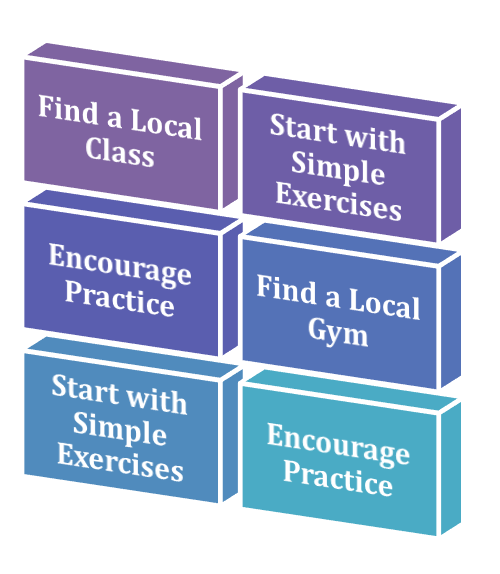
    • Find a Local Class: Look for a gymnastics class near you that offers classes for beginners. Many gyms have experienced coaches who can guide kids through the basics in a fun and safe environment.
    • Start with Simple Exercises: Gymnastics for beginners doesn’t require any advanced skills. Simple exercises like stretching, balancing, and rolling are a great way to introduce kids to what gymnastics is.How to Begin with Gymnastics for beginners?
    • Encourage Practice: Practicing at home can also help kids improve. Just make sure they have a safe space to try out simple moves under supervision.
    • Find a Local Gym: Look for gymnastics classes near you that offer classes for beginners. Many gyms have experienced coaches who can guide kids through the basics in a fun and safe environment.
    • Start with Simple Exercises: Gymnastics for beginners doesn’t require any advanced skills. Simple exercises like stretching, balancing, and rolling are a great way to introduce kids to what gymnastics is.
    • Encourage Practice: Practicing at home can also help kids improve. Just make sure they have a safe space to try out simple moves under supervision.

    Conclusion: The Lasting Benefits of Gymnastics for Kids

    The benefits of gymnastics are many, making it a great choice for kids who want to stay active, learn new skills, and grow both physically and mentally. Gymnastics for beginners is accessible, enjoyable, and provides valuable lessons that kids can apply throughout their lives. From building strength and confidence to making friends and learning discipline, gymnastics gives kids a strong foundation for a healthy and fulfilling life. 

    So, if you’re wondering what gymnastics is and whether it’s right for your child, consider the amazing benefits it offers. Gymnastics for beginners is a fun and exciting journey that can inspire kids, helping them reach their full potential in a supportive and positive environment.

  • How to Start Boxing? A Beginner’s Guide to Boxing Techniques and Training

    How to Start Boxing? A Beginner’s Guide to Boxing Techniques and Training

    How to Start Boxing? A Beginner’s Guide to Boxing Techniques and Training

    Boxing is an exciting sport that builds strength, speed, and confidence. If you’re interested in learning how to start boxing, this beginner’s guide will cover the basics, from essential boxing techniques to simple training tips. Whether you want to box for fitness or plan to step into the ring, understanding boxing for beginners can help you begin your journey effectively and safely.

    Why Choose Boxing?

    Boxing isn’t just fighting, it’s a total-body workout which improves the endurance of your body, stability and coordination. It’s a fantastic exercise to build muscle, relieve stress, relax, and master self-defense. A lot of people begin boxing to increase confidence and mental strength. Boxing for beginners is as easy or as intensive as you wish and is appropriate for anyone of all fitness levels.

    How to Start Boxing?

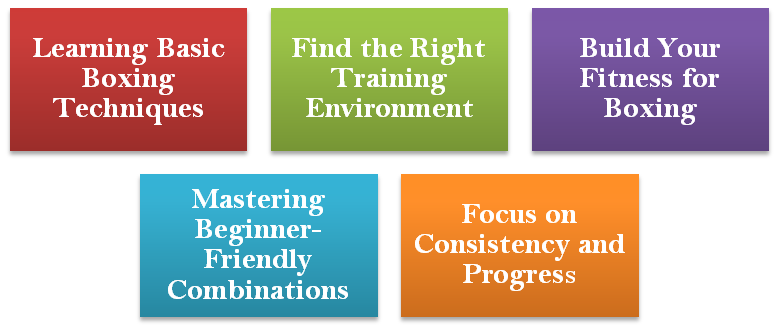
    Step 1: Learning Basic Boxing Techniques

    The first step to begin boxing is knowing the fundamental techniques of boxing. Knowing these basics will allow you to feel more at ease as you advance and keep your training secure. Here are some fundamental tips for beginners to learn boxing:

    How to Start Boxing?

    1. The Boxing Stance: A solid stance is the basis of any boxing technique. Keep your feet shoulder-width apart. the dominant foot slightly back with knees bent slightly, and your hands stop your face. This posture helps stability, mobility, and security.

    2. Basic Punches:

    • Jab: This fast, straight punch is a boxer’s most important tool. Jabs can be used to control distance and help set up other punches.
    • Cross: A strong straight strike using your back hand. It’s a great follow-up to an attack.
    • Hook: It is a punch that is thrown in a circular manner directed at the opposite side of your opponent’s body or head.
    • Uppercut: A downward punch that targets the opponent’s chin. It is particularly useful in close proximity.

    3. Footwork: Footwork is vital for moving in balance, staying clear of punches. For beginners, the basic footwork involves walking forward, backward and in a sideways direction. Training your feet will allow you to stay light on your feet as well as improve the agility of your feet.

    4. Defense Techniques: Learning to defend is just as important as learning how to punch. Start by blocking as well as slips and then ducking. These boxing defensive techniques will ensure your safety during training.

    Step 2: Find the Right Training Environment

    If you’ve learned the basics of boxing skills, the next step to learn the process of starting boxing is to find the ideal training space. It may be a local gym or your own home if you’re only starting out with boxing to keep fit. A gym is a great option for those who want instruction and equipment. However, you can also practice basic drills and shadow boxing at your own home.

    If you’re considering joining the gym, make sure you choose beginner-friendly classes, or instructors who are experienced in boxing for beginners. A welcoming environment can help to learn the basics, without fearing being overwhelmed.

    Step 3: Build Your Fitness for Boxing

    Boxing demands endurance and strength as well as speed, which is why physical fitness is vital. Here’s a quick exercise routine for beginners in boxing:

    1. Cardio Training: Jogging, jumping rope or running can help to increase endurance. The practice of jumping rope is especially popular in boxing for beginners since it enhances footwork as well as cardiovascular health.

    2. Strength Training: Work on bodyweight exercises, such as push-ups, squats as well as the core exercises (e.g. planks, push-ups). They build the strength required to punch efficiently.

    3. Shadowboxing: Shadowboxing is an easy way to learn boxing skills without any equipment. Place yourself in the mirror, take your boxing stance and then go through the simple punches, footwork and defensive techniques. Shadowboxing helps to develop coordination and rhythm.

    4. Bag Work: If you have access to punching bags, make use of it to train your footwork and punches. Begin with basic combinations like jab-cross and concentrate on maintaining your posture and technique.

    Step 4: Mastering Beginner-Friendly Combinations

    In boxing, combos are patterns of punches that are arranged to flow. Training in combinations helps you become more flexible and enables players to stay in suspense. Here are a few easy combinations for boxing beginners:

    1. Jab, Jab, Cross: This is a simple and effective combo to learn how to control distance and add power.

    2. Jab, Cross, Hook: A basic combination that includes a close-range punch, helping you become comfortable with different angles.

    3. Jab, Cross, Uppercut: This combo is useful for targeting the head and body, adding variety to your practice.

    As you progress, concentrate on improving your boxing technique to ensure that each punch feels controlled and smooth.

    Step 5: Focus on Consistency and Progress

    Consistency is essential when you are learning how to start boxing. Begin with a few training sessions each week, then gradually increase the frequency and intensity as you gain. Boxing for beginners may seem intimidating, but with perseverance it will become easier and the skills will become automatic.

    Try setting goals to monitor your performance. For instance, you could set a goal to complete a specific number of shadow boxing rounds or master a particular boxing technique. Set small, attainable targets will help you stay motivated and provide you with satisfaction.

    Tips for Beginners on Staying Safe

    Boxing is physically demanding so it is essential to be safe. Here are some safety tips for beginners in boxing:

    1. Warmup and Cool Down: A proper warm-up protects you from injury and helps prepare your body to train.

    2. Wear Protective Gear: If you are practicing sparring or on a bag you should wear gloves and wraps for your hands. They shield your wrists and hands from injury.

    3. Listen to Your Body: Make breaks as needed Don’t force yourself through discomfort. Recovery is an essential part of a successful training.

    Join Ramagya Sports Academy for Boxing!

    Enjoy the thrill from boxing with Ramagya Sports Academy! Classes are created to improve your speed, power and agility while improving your health and fitness.

    Our enthusiastic coaches are committed to helping you develop both mentally and physically by fostering confidence and self-control along the way. We welcome everyone from beginners to experienced boxers in a welcoming and supportive atmosphere.

    Train in our fully-equipped space, which includes boxing rings and punch bags. Take on the challenge and become part of an online community with a similar enthusiasm. Join today to begin your journey to boxing!

    Conclusion

    Learning how to start boxing may seem challenging, but it’s a rewarding journey. By focusing on fundamental boxing techniques, building a good fitness foundation, and staying consistent, you can make great progress in boxing for beginners. Whether you aim to improve fitness or learn a new skill, boxing offers endless benefits. So lace up your gloves, stay patient, and enjoy the journey of mastering boxing!

  • Should You Workout When You are Sick? 

    Should You Workout When You are Sick? 

    Should You Workout When You are Sick? 

    When you’re feeling under the weather, it can be challenging to decide whether to stick to your fitness routine or take a break. This blog will help you understand the best approach to working out while sick, considering the impact on your body and overall health.

    Should you workout when you are sick? Understanding Your Symptoms

    Before beginning an exercise routine, it’s essential to evaluate how severe your symptoms are. Are they mild – like runny nose – or more serious – like fever and body aches? Understanding your symptoms will enable you to make a more informed decision regarding fitness regime.

    • Common Cold Vs. Flu: Before deciding to work out, it’s essential to assess how you feel. Are your symptoms mild, like a runny nose, or more severe, like a fever or body aches? Understanding your symptoms can help you make an informed decision about your fitness routine.
    • Fatigue Levels: Check your energy levels carefully. If you feel excessively exhausted, that could be an indicator that your body needs rest rather than exercise. Fatigue is often a signal from our bodies telling us they’re working on recovery – pressing through can lead to further setbacks in recovery efforts.
    • Duration of Illness: If you have been sick for several days and still do not feel better, take note: prolonged illness often necessitates extra rest – don’t hurry the process of recovery!

    Benefits of Light Exercise

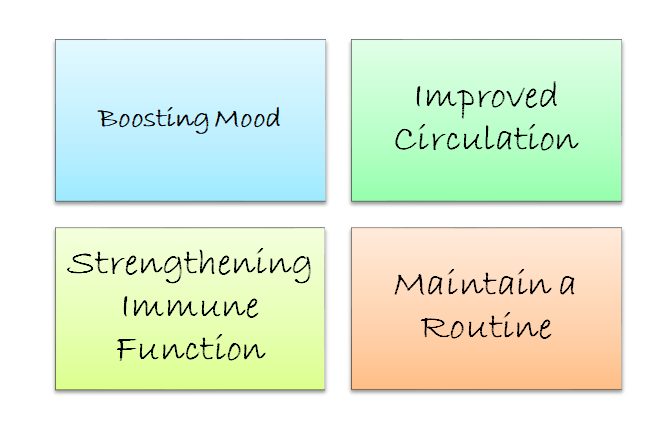
    • Boosting Mood: Light exercise such as walking or stretching can help elevate your mood and provide a sense of achievement. Physical activity releases endorphins which improve overall well-being – even when we’re feeling less-than-great!
    • Improved Circulation: Gentle movements may help promote better blood circulation, which could help your body in fighting off illness more efficiently as well as decrease the feelings of fatigue and stiffness.
    • Strengthening Immune Function: Engaging in light activity can strengthen your immune system. Studies indicate that engaging in regular moderate exercise may reduce colds’ duration and boost your immunity more quickly, helping you recover quicker after getting sick.Benefits of Light Exercise
    • Maintain a Routine: Light exercise can be an invaluable way to keep yourself on track with your fitness goals, providing a steady dose of mental and motivational benefits throughout recovery. This consistency can also help your mental wellbeing and recovery from sickness.

    What Are the Risks of Exercising When Sick?

    What Are the Risks of Exercising When Sick?
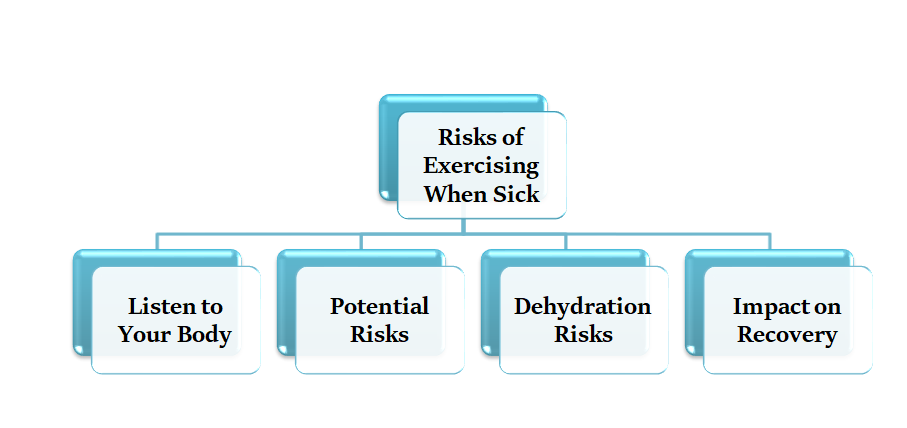
    • Listen to Your Body: When exercising when ill, it’s essential to pay close attention to how your body responds. Pushing yourself too hard could worsen symptoms and lengthen recovery time, further prolonging an illness and disturbing a fitness routine.
    • Potential Risks: Exercising while suffering from severe symptoms can put extra strain on the body. For instance, exercising while suffering from respiratory conditions like coughs or chest congestion could make breathing harder while potentially worsening their condition.
    • Dehydration Risks: When sick, your body can become dehydrated quickly due to fever or digestive issues. Exercising further exacerbates dehydration, potentially leading to dizziness or fainting if performed while not sufficiently hydrated.
    • Impact on Recovery: Overexerting yourself can hinder your healing process. If your body is busy trying to repair itself, adding stress from workouts could prolong their illness and slow your return to regular fitness regimen.

    When to Skip Workout

    • The “Neck Rule”: As a common guideline, one useful way of understanding when exercise may help your condition is the “Neck Rule.” If symptoms appear above your neck (such as mild cold), light exercise may be beneficial; otherwise if they are below it (such as chest cold fever or digestive problems) then not working out may be the best advice.
    • Rest is Essential: Allowing yourself time for rest is critical in recovering from illness; your immune system works hard at fighting against it and adding extra strain from exercise may interfere with its efforts.
    • Persistent Symptoms: If fever, chills or significant fatigue continue to appear for no apparent reason, this is an indicator that your body needs rest and cannot handle exercise at this time. Continuing with exercise could worsen your condition and slow recovery times down further.
    • Seek Professional Advice: When in doubt, consult a healthcare professional. They can check your symptoms and advise whether it’s safe for you to resume physical activity.

    Modifying Your Fitness Routine

    • Modify Your Workouts: If you decide to exercise, consider modifying your fitness routine. Instead of intense workouts, opt for low-impact activities like walking, yoga, or gentle stretching. This allows you to stay active without overexerting yourself.
    • Focus on Recovery: Incorporate recovery practices into your routine, such as proper hydration, nutrition and restful sleep to help the healing process while keeping up some level of fitness. These elements will help your body while keeping up with physical demands of training.
    • Shorter Sessions: When exercising, reduce the duration of each workout session as much as possible to help alleviate fatigue while still maintaining some physical activity. This may help ensure an efficient workout while still remaining active.
    • Listen to Your Body When Exercising: If any discomfort or worsening symptoms appear while exercising, stop immediately and put your health before anything else – this applies particularly if sick. Always put priority on how your body feels before beginning any workout program, particularly while sick.

    Conclusion: Listen to Your Body

    Should you workout when you are sick? When it comes to working out when sick, the decision depends on your symptoms and overall health. While light exercise may provide benefits when dealing with mild cold symptoms, it’s crucial that you prioritize your health first and listen to what your body tells you. Skipping your fitness routine temporarily to allow for recovery is often the best choice.

    Consult a healthcare professional if you have any doubts about exercising when sick. By taking proper care for yourself, taking a break may actually strengthen and revitalize you in return; your body will thank you!

    Read More: Everything You Need to Know About Working Out at Home or Gym

  • What Makes HIIT Effective for Weight Loss?

    What Makes HIIT Effective for Weight Loss?

    What Makes HIIT Effective for Weight Loss?

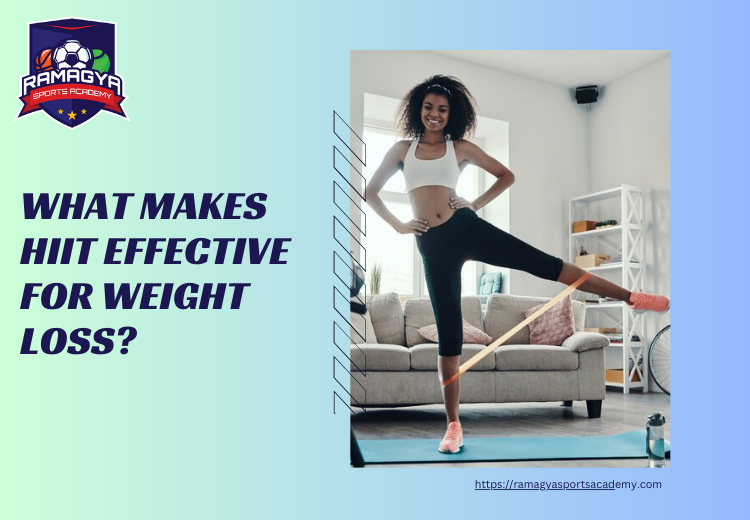
    In recent years, HIIT workouts have become increasingly popular for those wanting to lose weight quickly and efficiently. But what exactly makes HIIT workouts so effective for weight loss? High-Intensity Interval Training, or HIIT, involves short, intense bursts of activity followed by brief rest periods, creating an efficient workout that maximizes calorie burn. 

    Here, we’ll explore why a HIIT workout is a top choice for weight loss and how it helps you shed pounds.

    Why HIIT Workout Burns More Calories?

    The “afterburn” effect is one of the key reasons why HIIT is effective in weight loss. After intense exercise, the body requires extra oxygen for recovery and restoration. This phenomenon is scientifically known as “Excessive Post-Exercise O2 Consumption” (EPOC). It causes your body to burn calories after you stop working out. In contrast to steady cardio where the calorie burning stops once you’ve finished, HIIT weight loss workouts continue to burn calories for several hours.

    Top benefits of HIIT workouts for weight loss

    1. Efficiency and Time-Saving

    The efficiency of a HIIT exercise is one of its top benefits. You can burn calories in just 15-20 minutes. Those with busy schedules will find HIIT a great workout.

    2. Increased Fat Burning

    High-intensity workouts are effective for weight loss. Studies show that high intensity exercise burns fat, not muscle. This means you can lose weight without losing muscle. A HIIT is the perfect workout if you want to slim down but keep your strength.

    3. Boosted Metabolism

    Your metabolism will increase during a HIIT exercise and remain elevated afterward. This is particularly helpful for weight-loss as it means you burn more calories throughout the day. The long-lasting effect of HIIT exercises for weight-loss makes them an effective tool for burning calories.

    4. Improves Heart Health

    Exercises that are high intensity and short in duration can be beneficial for cardiovascular health. They can also help you lose weight.

    HIIT workouts for weight loss

    1. Tabata-Style HIIT Workout

    • 20 burpees followed by 10 seconds rest
    • High knees for 20 seconds, then 10 seconds rest

    Repeat this for 4 minutes

    Although this workout is short, it is intense and great for burning calories.

    2. Bodyweight HIIT Circuit

    • 30 seconds of squats followed by 10 seconds rest
    • 30 seconds of push ups followed by 10 seconds rest
    • 30 seconds of jumping Jacks, followed by 10 seconds rest

    This circuit can be repeated 3-4 times to burn calories quickly.

    3. HIIT Cardio Exercise on the Treadmill

    • Sprint for 1 minute, walk for 1 minute

    Repeat for 15-20 minutes. The combination of cardio and high intensity makes this workout perfect for weight loss.

    Tips to Get the Most Out of HIIT Workouts For Weight Loss

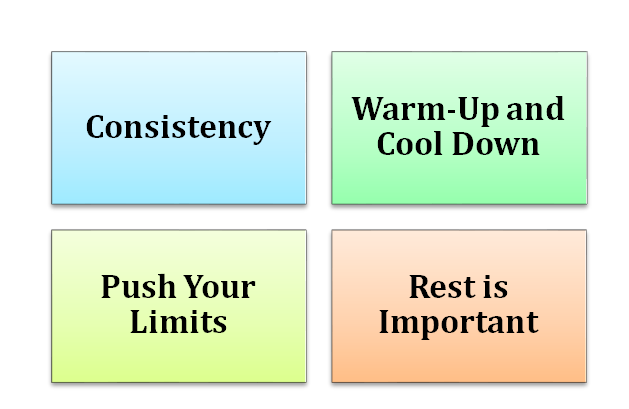
    1. Consistency: Your body will respond to a regular exercise schedule better if you are consistent.

    2. Warm-Up and Cool Down: HIIT is a high intensity workout that can be intense. To prepare your muscles, always begin with a warm up and finish with a cool down to help in recovery.

    Tips to Get the Most Out of HIIT Workouts For Weight Loss

    3. Push Your Limits: HIIT is all about intensity. To maximize your calorie burning, push yourself to the limit during these short bursts.

    4. Rest is Important: Because of the intensity and duration of HIIT sessions, it is important to give your body time to recover. Allow your muscles to rest between HIIT sessions.

    Why choose hiit workout?

    Why choose hiit workout?

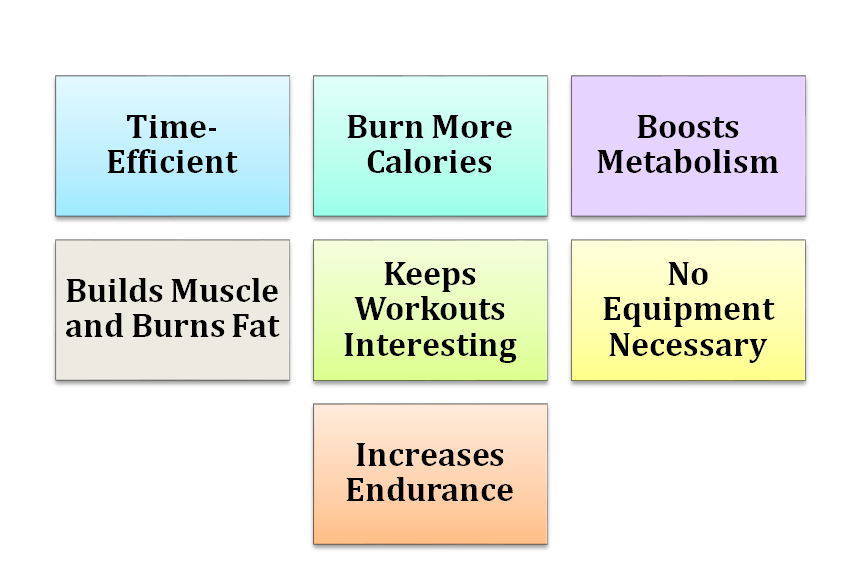
    1. Time-Efficient

    These workouts tend to be shorter than other workouts. They can last anywhere from 20-30 minutes. Because of this, they are perfect for those with busy schedules.

    2. Burn More Calories

    HIIT can burn more calories in a shorter period compared to steady-state cardio. The high intensity means you’re working harder, leading to greater calorie expenditure.

    3. Boosts Metabolism

    The intense bursts of activity increase your metabolism, allowing you to burn calories even after your workout is over. This effect is known as excessive post-exercise oxidation (EPOC). It can last hours.

    4. Builds Muscle and Burns Fat

    HIIT is a combination of strength training and cardio exercises that promotes muscle building while also promoting fat reduction. Over time, this leads to a better body composition.

    5. Keeps Workouts Interesting

    HIIT is a great way to keep your workouts interesting. By mixing and matching exercises, you can prevent boredom and maintain motivation.

    6. No Equipment Necessary

    You can do many HIIT exercises with your own body weight. This makes them easy to do anywhere, at home, the gym or outside.

    7. Increases Endurance

    HIIT increases both anaerobic and aerobic fitness. It helps you to become stronger and more resilient when participating in sports and other physical activities.

    Tips for getting the best out of HIIT workouts

    Here are some tips to help you get the most out of your HIIT workouts.

    1. Warm Up Properly

    Warm up your body with 5-10 minutes of dynamic stretching, light jogging or mobility drills to increase your heart rate. These exercises can reduce your risk of injury and help you raise your heartrate.

    2. Focus on Form

    Correct form is essential to avoid injuries and maximize your effectiveness. Make sure you do each exercise correctly, even if that means reducing the intensity or slowing down.

    3. Push Yourself During Intervals

    Don’t be afraid to give your best effort during the HIIT intervals.

    4. Use a Timer

    Many apps and interval-timers are available to help you keep track of the sessions.

    5. Stay Hydrated

    Stay hydrated before, during and after your workout. Water is essential to maintain performance and to aid in recovery.

    6. Mix Up Your Exercises

    Include a variety of exercises to target various muscle groups. Combine cardio, strength and bodyweight movements.

    7. Cool Down and Stretch

    Take 5-10 minutes after your workout to stretch and cool down. It will help your heart rate to return to normal, and it will reduce muscle soreness.

    Conclusion

    In conclusion, HIIT workouts are highly effective for weight loss because they maximize calorie burn in a short amount of time and boost metabolism. Incorporating HIIT into your routine can lead to significant weight loss results and promote a healthier lifestyle. Embrace the challenge and see your fitness journey transform!

  • What Are the Benefits of Playing Chess for Brain Development? 

    What Are the Benefits of Playing Chess for Brain Development? 

    Chess has often been seen as a game that requires intelligence, strategy and skill. Did you know playing chess has many benefits for the brain? This game can help you improve your cognitive function, sharpen your brain, and boost problem-solving skills. 

    Let’s explore the various benefits of playing chess, learn how to play chess if you’re a beginner, and understand how chess competitions work.

    Benefits of Playing Chess for Brain Development

    It’s not just a fun game, but a way to improve your mental health. Here are the most important benefits of playing chess:

    Benefits of Playing Chess for Brain Development
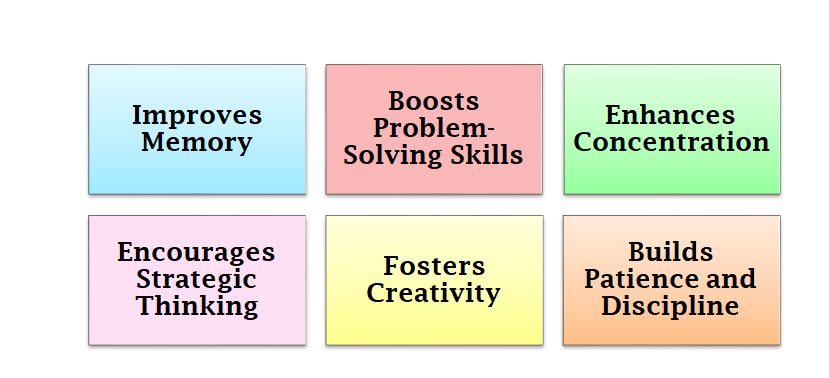
    • Improves Memory: While playing chess you have to remember past moves, strategies and positions. This helps your brain retain information and recall it at the right time. This helps to improve your short-term as well as long-term memory.
    • Boosts Problem-Solving Skills: One of the most valuable benefits of playing chess is that it teaches you how to think critically and solve problems. You are always faced with decisions in chess that require you think ahead, predict your opponent’s move, and find solutions.
    • Enhances Concentration: Chess requires a high level of concentration. You will become better at concentrating over long periods of time the more you play. This can help you focus better on your daily tasks, studies, and work.
    • Encourages Strategic Thinking: Chess encourages strategic thinking because every move is important. You will learn to think strategically and plan your moves several moves in advance.
    • Fosters Creativity: While chess may seem like a rigid game, it actually requires a lot of creativity. The creative side of your brain is stimulated when players are forced to think up new moves to get out of tricky situations or to surprise their opponent.
    • Builds Patience and Discipline: Chess teaches patience. It’s important to be patient and have discipline. These are traits that can be used in both chess and everyday life.

    How to Play Chess for Beginners

    If you’re new to the game, don’t worry! Learning how to play chess for beginners is easy, and with practice, you’ll improve quickly. Here’s a basic guide to help you get started:

    1. Chess Board and Pieces: Chess is played on a board that is divided into 64 squares of alternating color (black and White). Each player has 16 pieces, including a king, a queen, two rooks and two knights. There are also two bishops. Checkmate is the goal, where you try to capture your opponent’s King.
    1. Basic Moves:

        – Pawns: Move forward one square but capture diagonally.

        – Rooks: Move any number of squares horizontally or vertically.

        – Knights: Move in an “L” shape, two squares in one direction and then one square at a right angle.

        – Bishops: Move diagonally any number of squares.

        – Queen: Can move in any direction, both horizontally and diagonally, for as many squares as available.

        – King: Moves one square in any direction.

    1. Special Moves:

        – Castling: A move where the king and rook move simultaneously to protect the king.

        – En Passant: A unique pawn capture that can happen only under certain conditions.

        – Promotion: When a pawn reaches the other side of the board, it can be promoted to any piece (except a king).

    1. Check and Checkmate: If your opponent’s king is under attack, they are in “check” and must make a move to protect it. If the king cannot escape, it is “checkmate,” and the game ends.

    Entering Chess Competitions

    Once you’ve learned the basics of chess and practiced enough, you might want to enter a chess competition. Competing against other players can help you improve your skills and push your mental limits.

    Here are a few tips for participating in a chess competition:

    After you have mastered the basic rules of chess, and you have practiced enough to master them, you may want to participate in a chess tournament. You can improve your skills by competing against other players.

    Here are some tips on how to participate in a chess tournament:

    how to participate in a chess tournament

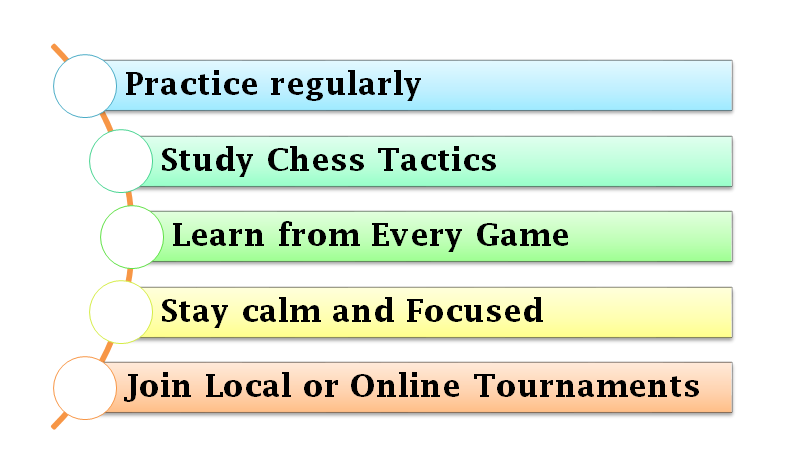
    1. Practice regularly: Practice as much as possible before entering a chess competition. You can develop your strategies by playing with family members, friends or online opponents.

    2. Study Chess Tactics: The top players in chess tournaments are familiar with common tactics, such as pins, forks and sacrifices. These can give you a competitive edge.

    3. Learn from Every Game: Each match, no matter if you win or not, will teach you something. Analyze the games you played to see what went well and where you can improve.

    4. Stay calm and Focused: Chess tournaments are intense. But staying calm and thinking clearly is crucial. Focus on every move. A single mistake could cost you the match.

    5. Join Local or Online Tournaments: You do not have to be a Grandmaster to participate in a chess Competition. Competitions are available for all levels of players, from beginners to experts. Start with smaller events and work your way to the more competitive ones.

    Master the Game of Kings Chess at Ramagya Sports Academy

    Ramagya Sports Academy is the top destination for aspiring players of chess in Noida. The academy is committed to nurturing young talents and cultivating a love of the game. It emphasizes chess as a powerful and effective tool for intellectual development.

    We offer modern facilities and coaches with great experience to help players of any age and ability. Expert instructors will guide you on your chess journey, whether you are a beginner or advanced player.

    The curriculum is comprehensive and covers every aspect of the game including tactics, strategies, openings, middlegames, endgames as well as psychological preparation. Ramagya Sports Academy aims to help students improve their chess abilities.

    Conclusion

    It’s clear that benefits from playing chess go beyond having fun. Chess helps develop the brain in many ways. It can improve memory, concentration and patience.

    So, why not give it a try today? You’ll not only improve your brainpower but also discover a new passion!

    Frequently Asked Questions (FAQs)

    What age is best to start teaching kids chess?

    Kids can usually start learning chess around age 5 or 6, but it really depends on the child.

    Can playing chess help kids do better in school?

    Yes, some studies show that playing chess can help improve math and reading skills because it encourages logical thinking.

    How can I teach my child the basics of chess?

    Start by explaining the rules and how each piece moves. You can use fun online resources, apps, or kid-friendly books.

    Which chess academy is best for beginners?

    Many academies welcome beginners, but it’s good to find one like Ramagya Sports Academy that focuses on teaching the basics in a supportive way.

  • What is Contemporary Dance?

    What is Contemporary Dance?

    What is Contemporary Dance?

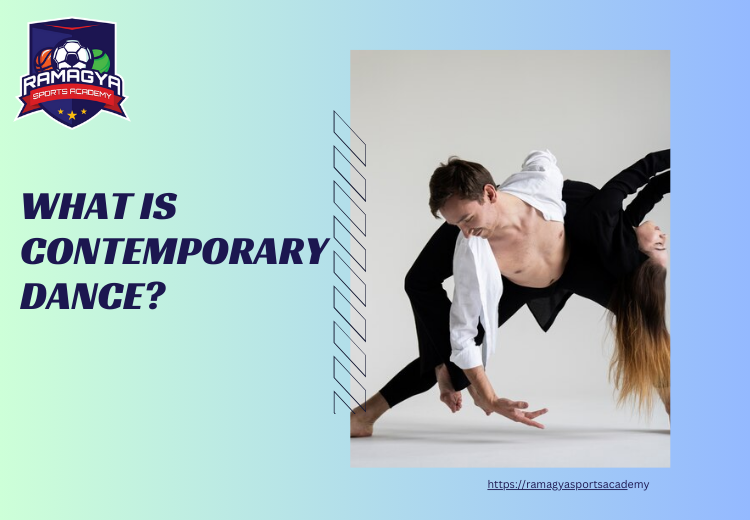
    Contemporary dance is a unique form that blends various movements and techniques into an expressive performance, emphasizing emotions and ideas through movement. As opposed to more traditional forms, contemporary dance allows dancers to explore more freely their bodies and the space around them, including ballet, jazz, and modern dance, contemporary dance is highly versatile.

    Contemporary dance is highly adaptable and improvisatory techniques from each of these genres make each performance special and engage the audience while conveying stories and emotions through movement and inviting viewers to interpret and respond to its art as they see fit.

    The Origins of Contemporary Dance

    Contemporary dance first emerged as a movement within dance during the early 20th century as a reaction against more classical forms, specifically ballet. While ballet relied heavily on strict technique, contemporary dance allowed for greater freedom of movement and personal expression through personal expression through dance. Contemporary dance emerged due to pioneering choreographers exploring new ways of moving and telling stories through dance.

    Isadora Duncan was one of the early innovators of contemporary dance. She believed dance should reflect natural body movements rather than rigid poses. She advocated fluidity and grace drawn from nature and everyday life as sources of inspiration. Martha Graham introduced dance as an expressive means to convey emotions and narratives by emphasizing natural body movements to communicate deeper feelings.

    Contemporary Dance Today

    Contemporary dance has never been more prevalent, appearing at theaters, dance festivals and public spaces alike. Dancers trained in various styles bring their unique voices to the art form while choreographers push boundaries by exploring themes, technologies and movement possibilities that open new horizons for choreographers and their dancers alike.

    Dance companies around the world showcase contemporary works, often collaborating with artists from different disciplines, such as theater, music, and visual arts. This interdisciplinary approach enriches the experience for both performers and audiences, creating innovative and thought-provoking performances.

    1. A Fusion of Styles: The Eclectic Tapestry of Contemporary Dance

    Contemporary dance is an exhilarating mix of different forms of movement that include ballet, jazz and modern dance components. This eclectic tapestry creates an exciting, dynamic art that allows dancers to transcend traditional boundaries while exploring new possibilities that come alive through movement. As opposed to classical ballet which can often be rigid in terms of technique and interpretation, contemporary dance is more flexible, celebrating creativity while providing dancers an outlet to demonstrate imagination through varied moves as well as gestures.

    1. The Power of Improvisation: Embracing Spontaneity in Contemporary Dance

    Contemporary dance stands out as being unique because of its emphasis on improvisational techniques. Improvisation accelerates every performance with spontaneity and emotional depth, in stark contrast with choreographed routines of other dance forms. Contemporary dancers frequently participate in improvised patterns which allow them to respond instinctively to music, exploring depth of artistic inclinations while creating an air of uncertainty among audiences with spontaneity of dancers and freedom of expression.

    1. Embodying Narrative Through Movement: The Expressive Potential of Contemporary Dance

    Dance is an effective means of storytelling, enabling dancers to convey stories while stirring emotions through movement. Combining movements, spatial dynamics and theatrical elements with dance performances, contemporary dancers bring abstract concepts and emotional issues alive for viewers through movement – whether it’s the loss of love or reflection on social issues; contemporary dancing allows audiences to engage emotionally in an experience through dance. Dancing in the present can also provide an effective means of conveying human emotion without words to make an emotional statement that resonates.

    1. The Evolution of Contemporary Dance Steps: Innovations and Boundless Creativity

    Contemporary dancers’ step dance repertoire can be identified by its constant evolution as choreographers and dancers search for innovative ways to convey their ideas through dance. Ranging from delicate floor movements to rapid turns and leaps, contemporary dance steps showcase its infinite imagination and creativity inherent in this form of art. Dancers add personal interpretations into every move they perform bringing life and emotion to each performance they deliver.

    Conclusion

    At the conclusion of our lessons in contemporary dance steps, we hope that you have gained an increased awareness of its many artistic qualities. You may be inspired to begin dancing or simply marveled by its beauty. Contemporary dance steps provide us with endless opportunities for expression through art while honoring body language as a form of communication.

    Let the stunning, mesmerizing beauty of contemporary dance inspire your imagination and awaken your senses as you immerse yourself in its dynamic world of expression and enthusiasm!

    Frequently Asked Questions:

    1. Is contemporary dance good for beginners?

    Yes! Contemporary dance is great for beginners. Many dance classes offer lessons for all skill levels, focusing on basic movements and encouraging creativity.

    1. How does contemporary dance promote physical fitness in children?

    Contemporary dance involves various movements that enhance strength, flexibility, coordination, and endurance. Regular participation helps kids stay active and healthy.

    1. Can contemporary dance improve social skills in children?

    Yes! Dance classes encourage collaboration and teamwork, helping kids build friendships and develop important social skills.

    1.  Why is contemporary dance important for kids?

    Contemporary dance is important for kids because it encourages creativity, confidence, and self-expression. It’s a fun way for them to explore their feelings and connect with others through movement.

  • How can I Stay Fit at Home Without Equipment? Easy Workouts to Try! 

    How can I Stay Fit at Home Without Equipment? Easy Workouts to Try! 

    How can I Stay Fit at Home Without Equipment? Easy Workouts to Try! 

    Being fit doesn’t have to mean attending a gym or investing in expensive equipment. It is possible to keep in shape by doing simple exercises that do not require any particular equipment. A full-body workout that doesn’t require equipment is as effective as exercising in the gym
    In this blog, we’ll discuss some simple exercises at home that you could attempt and teach you how to keep fit using exercises that don’t require equipment.

    Why a No Equipment Workout is Great for You

    A no equipment workout offers many benefits. You can exercise whenever you want without having to purchase and store equipment. It’s ideal for those who do not want to visit the gym or are in a hurry. The full-body exercise with no equipment routine lets you work out all the major muscle groups with just your own weight. This makes it simple to do your own workout at home and it is efficient in helping you improve your strength, burn off fat and increase flexibility.

    Full Body Workout No Equipment: A Simple Guide

    A full-body workout that doesn’t require equipment is when you’ll use your body for resistance in the exercises. The great thing is, these exercises target a variety of muscles, providing an even workout. Here’s how to get started with a no equipment workout at home:

    1. Squats

    Squats are an easy exercise at home that works your legs, glutes, and core. Start by standing with your feet about shoulder width apart then lower yourself as if you were sitting down in your chair. Keep your spine straight. Then, rise up. Repeat for 10-15 reps. This full-body workout with no equipment moves improves your lower body strength and can help improve your balance.

    2. Push-ups

    Push-ups are an all-time classic no equipment exercise which targets your chest, shoulders, triceps, as well as your core. Begin in a plank position and place your hands spread out shoulder-width apart. Reduce your weight until the chest is level with the floor, and then push yourself up. If you find this difficult then you can alter the exercise by performing push-ups with your knees. Do 10-12 repetitions.

    3. Lunges

    Lunges are a good exercise that will work your legs and your core. Standing up begins by taking one step forward, then bring your body down until your knees are bent to 90-degree angles. Return to your starting position then switch your legs. Lunges are a great exercise for the whole body, no equipment required that increases strength and flexibility. Try to do 10 reps per leg.

    4. Plank

    The plank is an incredible fitness exercise that does not require equipment to strengthen your shoulders, back and arms. For a plank, begin by putting your body in a position of push-ups but keep your body straight all the way from toe to head and not moving. Make sure your abs are tight and keep your body in a straight line for 20-30 seconds minimum. This easy exercise at home helps strengthen your core and improve your posture.

    5. Glute Bridges

    Glute bridges are great to target your glutes, lower back and the hamstrings. Lay on your back, and bend your knees, and your feet firmly to the ground. Your hips should be lifted towards the ceiling, pressing your glutes on the highest point, then lower back to. This full-body exercise that requires no equipment is ideal to strengthen the lower part of your body. Do 12 to 15 repetitions.

    Benefits of a Full Body Workout No Equipment Routine

    A workout that does not require equipment is not just practical but also has a host of advantages. Here are a few of the reasons to try it:

    • Saves time: There is no need to go for a gym visit or set up any equipment. You can start anytime and from anywhere.
    • Cost-effective: There is no need to buy expensive equipment or gear.
    • Effective: A full-body exercise that doesn’t require equipment will strengthen muscles, increase endurance, and reduce calories.
    • Customizable: You can pick exercises that are suitable for your fitness level and objectives which makes it simple to maintain.

    Staying Motivated with No Equipment Workouts

    It’s easy for people to get lost in the moment or lose focus while working at home, but here are some suggestions to keep you focused:

    • Set a timer: Select specific times during the day when you can do your workout without equipment. Following a plan makes it much easier to keep your commitment.
    • Track your Progress: Note down your workouts and record the number of reps you’re performing or the length you can hold in a plank. This will allow you to see the progress you’ve made as time passes.
    • Finding a Workout Buddy: Exercise with a loved one or a family member can help you stay active and make the exercise more enjoyable.

    Conclusion

    Maintaining your fitness at home without equipment is achievable by following this full body workout no equipment. Through simple exercises that you can do at home such as squats, lunges, push-ups, and planks, you can achieve an effective workout routine. The no equipment workout will be incorporated into your routine as it is cost-effective and will work all major muscles of your body. 
    Try it and you’ll discover how simple it is to keep in shape with a full body exercise routine that requires no equipment!